


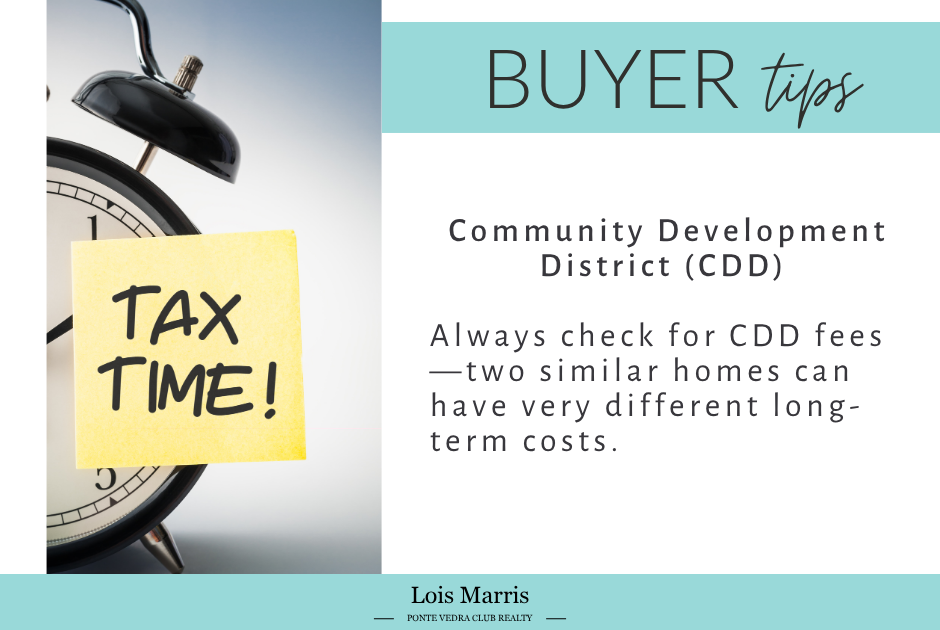
Home Buying Tip #12: Florida CDD Fees Explained
If you are looking at homes in Florida, especially in newer master-planned communities around Jacksonville, Ponte Vedra, Ponte Vedra Beach, Nocatee, or Del Webb Ponte Vedra, you may see something called a CDD fee.
And if you are like most buyers, your first thought may be:
“Is this just another hidden cost?”
It is a smart question. A CDD fee can affect your total monthly payment, your long-term cost of ownership, and even how one home compares to another home in the same community.
Let’s break it down in an easy to understand manner.
What Is the TRUE Monthly Payment of a Home?
It’s more than just the purchase price
Principal + Interest
includes CDD
Most buyers focus on price.
Experienced buyers focus on cost.
The list price is only part of the story. Understanding your full monthly cost helps you make a smarter buying decision.
What Is a CDD Fee?
CDD stands for Community Development District.
In Florida, a CDD is a special-purpose local government created to help finance, build, operate, and maintain infrastructure and community improvements. That may include things like:
- Roads and sidewalks
- Utilities and drainage systems
- Street lighting
- Clubhouses, pools, fitness centers, parks, and trails
- Common area landscaping and irrigation
Instead of the developer paying for all of those improvements upfront and building the entire cost into the home prices, the cost may be financed over time and paid back by homeowners through the CDD assessment.
Where Does the CDD Fee Show Up?
CDD fees are typically included on the property’s annual tax bill as a non-ad valorem assessment. You will likely see the bond and the maintenance portions combined into one amount. You can contact the appropriate CDD district to determine how much of the payment is bond vs maintenance. This will let you know if the bond portion has been paid off and/or how many years until the bond portion is paid off.
If you have a mortgage and escrow your taxes and insurance, that CDD cost may be included in your monthly mortgage payment. That is why it is so important to look beyond the listing price and understand the home’s full monthly cost.
The Two Parts of a CDD Fee
This is the part many buyers miss.
A CDD fee usually has two parts:
1. Debt Service
This is the portion that repays the bond used to build the original infrastructure and amenities. It is often paid over a long period of time, commonly 20 to 30 years.
In some communities, a homeowner may be able to pay off the bond portion early. If that happens, the annual CDD amount may be reduced.
2. Operations and Maintenance
This is the ongoing portion that helps maintain the community features, common areas, and services.
This portion generally does not go away. It may also change from year to year depending on the community’s budget.
Buyer Tip: When someone says “the bond is paid off,” that usually does not mean the entire CDD disappears. It usually means the debt portion is gone, but the operations and maintenance portion may remain.
Why Do CDD Fees Differ From One Home to Another?
This is one of the most confusing parts for buyers.
You may find two homes in the same general community, with similar sizes and prices, but different CDD amounts. That can happen for several reasons:
- Different phases: One section of a community may have been developed under different bond terms than another section.
- Bond payoff status: One homeowner may have paid off the bond portion, while another has not.
- Lot or assessment differences: Some properties may have different assessments depending on how the district was structured.
- Listing confusion: The amount shown in online listings may not always tell the full story.
That is why I always recommend verifying the actual tax bill and assessment information before comparing homes. You can also get an estimate of taxes at: https://www.sjcpa.gov/taxestimator/
CDD vs. HOA: What Is the Difference?
A CDD and an HOA are not the same thing.
| CDD | HOA | COA (Condo Association) |
|---|---|---|
| Usually appears on the property tax bill | Usually billed monthly, quarterly, or annually | Usually billed monthly and may be in addition to HOA fees |
| Helps pay for infrastructure and large community improvements | Helps manage community rules, appearance, and shared expenses | Helps maintain the building and shared structures |
| May include debt service and operations/maintenance | May include landscaping, amenities, management, or community services | May include exterior maintenance, roof, building insurance, reserves, and sometimes utilities |
Many Florida communities have both a CDD and an HOA, so buyers need to look at the complete picture. If you own a condo within an HOA, you will likely have a master HOA monthly fee plus the COA monthly fee.
Are CDD Fees Bad?
Not necessarily.
A CDD fee is not automatically good or bad. It is part of how certain communities are structured.
In some newer or master-planned communities, the CDD helps create the lifestyle buyers want: attractive entrances, landscaped common areas, trails, pools, clubhouses, fitness centers, and other amenities.
The real question is not simply, “Does this home have a CDD?”
The better question is:
“Does the total cost make sense for the lifestyle, location, amenities, and long-term value I am getting?”
A Simple Example
Let’s say you are comparing two similar homes:
- Home A: Lower purchase price, but a higher annual CDD fee
- Home B: Higher purchase price, but no CDD or a lower CDD
At first glance, Home A may look like the better deal. But once you factor in the CDD, taxes, HOA dues, insurance, and maintenance, the answer may change.
This is why I encourage buyers to compare homes based on true monthly cost, not just purchase price.
A Quick Note for 55+ Buyers
If you are considering a 55+ community in the Jacksonville or Ponte Vedra area, CDD fees are just one part of the fee conversation.
Some 55+ communities may have a CDD. Others may not. Some may have HOA fees, condo fees, or both. For example, Sweetwater by Del Webb in Jacksonville does not have a CDD fee, while some newer communities in the broader area may.
Because 55+ communities often include amenities, maintenance, social programming, and different property types, I recommend looking at the full monthly cost and what is included.
55+ Community Fees Explained - Jacksonville and St Augustine FL
Questions to Ask Before Buying a Home With a CDD
- What is the total annual CDD amount?
- How much is debt service and how much is operations and maintenance?
- Has the bond portion been paid off?
- If the bond is not paid off, when is it scheduled to end?
- Can the bond be paid off early?
- What are the HOA fees in addition to the CDD?
- Are there Condo Owner Association fees (COA) in addition to HOA and CDD fees?
- What amenities and services are included?
- How does the total monthly cost compare to similar homes without a CDD?
My Advice
Do not automatically rule out a home because it has a CDD fee. But do not ignore the CDD fee either.
A CDD can be part of the reason a community looks beautiful, feels well-planned, and offers the amenities buyers want. But you need to understand what you are paying, how long you will pay it, and how it affects your overall budget.
As your buyer’s agent, I help you look past the surface-level listing information and compare the real numbers.
Thinking About Buying in Jacksonville, Ponte Vedra, or Ponte Vedra Beach?
If you are comparing homes in communities with different fees, I can help you understand the full cost before you make an offer.
I will help you look at the CDD, HOA fees, property taxes, insurance considerations, amenities, location, and resale potential so you can make a confident decision.
Call or text me at 904-373-8033
Send a message here
Start your home search here
Frequently Asked Questions About Florida CDD Fees
What does CDD stand for in Florida real estate?
CDD stands for Community Development District. It is a special-purpose local government used to help finance and maintain infrastructure and community improvements in certain Florida communities.
Are CDD fees included in property taxes?
CDD fees are commonly included on the annual property tax bill as a non-ad valorem assessment. If your taxes are escrowed, the cost may be included in your monthly mortgage payment.
Do CDD fees ever go away?
The debt service portion may go away when the bond is paid off. The operations and maintenance portion generally continues because it helps maintain community improvements and services.
Can two homes in the same community have different CDD fees?
Yes. CDD fees may differ based on phase, bond terms, lot assessment, or whether a prior owner paid off the bond portion.
Is it bad to buy a home with a CDD fee?
Not necessarily. A CDD fee is one part of the total cost of ownership. The key is understanding what the fee covers and whether the total cost makes sense for your budget and lifestyle.
Explore the Full Series: Home Buying Tips
- Begin Saving for Your Down Payment
- Get Your Credit Report
- Get Your W2 and Tax Return Documents in Order
- Get Pre-Approved
- Make a List of Must-Haves and Wish List Items
- Follow a Budget
- Get a Good Real Estate Agent
- Home Inspections
- Negotiations Part 1
- Negotiations Part 2
- Take Notes When Visiting Homes
- CDD Fees Explained ← You're here